In Germany, known for its precision and accuracy in all areas of life, there is also a complex tax system. The tax classes in Germany are an important aspect to understand if you want to work, invest, or simply comprehend how the economy of one of Europe’s most influential countries functions. In this article, we take a closer look at the German tax classes and how they affect people’s finances.
What are the tax classes in Germany?
In many countries, the tax class is simply a percentage that a taxable person pays. In Germany, however, the tax class not only determines the tax rate, but also other elements related to tax obligations.
The tax classes in Germany are heavily dependent on the life situation of the taxable person. They are assigned based on criteria such as marital status, presence of children, or type of employment. Understanding which tax class one is assigned to can aid in financial planning and help avoid unpleasant tax surprises.
Closely linked to the tax classes in Germany are the tax benefits – membership in a particular group determines the possibility of using various deductions. However, there is no universally best tax class, as everything depends on the individual situation of the taxable person. The system was designed to provide the best possible opportunities to all individuals earning income in this country.
A simple tax return in 12 minutes?
Choose Taxando!
Tax class 1 – for single individuals
Persons in tax class 1 are mainly single taxpayers without children. This also includes divorced and widowed individuals, but only if at least one year has passed since the death of the spouse.
In this category, the normal tax rate applies, although taxpayers can benefit from a tax-free amount or a flat-rate income. Additionally, there is a simpler and faster settlement process without the need to prove claims for various benefits – however, this can be less advantageous in many cases.
Working individuals often wonder, whether it is worthwhile to file a tax return for tax class 1? This is not always mandatory and sometimes offers the possibility of obtaining a significant tax refund – however, this depends on the personal situation.
Tax class 2 – for single parents
The second tax class in Germany is aimed at single parents who raise at least one child independently and meet certain conditions. It is available to those who live alone with their child and are neither married nor in a registered partnership (appropriate documents may be required).
A characteristic feature of the second tax class is the possibility of benefiting from an additional child allowance – in 2025, this amounts to 4260 euros for the first child and increases by 240 euros per year for each additional child.
Tax class 3 – for low-income couples
The third tax class in Germany is intended for married or registered partnership couples with low income. This category applies to couples where the income is mainly earned by one person or the income of the other person is significantly lower – in such cases, the combination of classes 3 and 5 is chosen. This leads to favorable tax rates and joint tax benefits, reducing the tax burden.
It is important to note that persons in the third tax class are required to report annually to the German tax office.
Tax class 4 – for married or registered partnerships
The fourth tax class is automatically assigned upon marriage or registered partnership. It is possible when the partner also chooses the fourth tax class. This class is advantageous for couples where both individuals earn similar amounts.
Tax class 5
The fifth tax class in Germany is mainly for married couples or those in a registered partnership where one person earns significantly more than the other. Typically, the person with the lower (or no) income is classified in tax class 5, while the person with the higher income is in class 3.
In class 5, advance tax payments are set less favorably for the taxable person. The advance payments are higher than in class 4, but lower than in class 6. Therefore, couples usually choose this tax class only when one person’s income significantly exceeds that of the other.
Tax class 6 – for individuals with a second job
The sixth tax class (tax class 6) in Germany is intended for individuals with more than one job. Those with multiple sources of income must tax each separately, with higher tax rates applying to one of these jobs than in other classes. Moreover, no tax deductions from income are possible in this class.
Is it possible to change the tax class?
A change of tax class is usually necessary when the personal status changes – such as in cases of marriage, divorce, the start of a separation phase, or the death of a partner. A change also occurs when someone takes on an additional job or their income changes significantly. In certain cases, one can choose the tax class – then one decides for themselves about membership in a particular group, but must take certain steps.
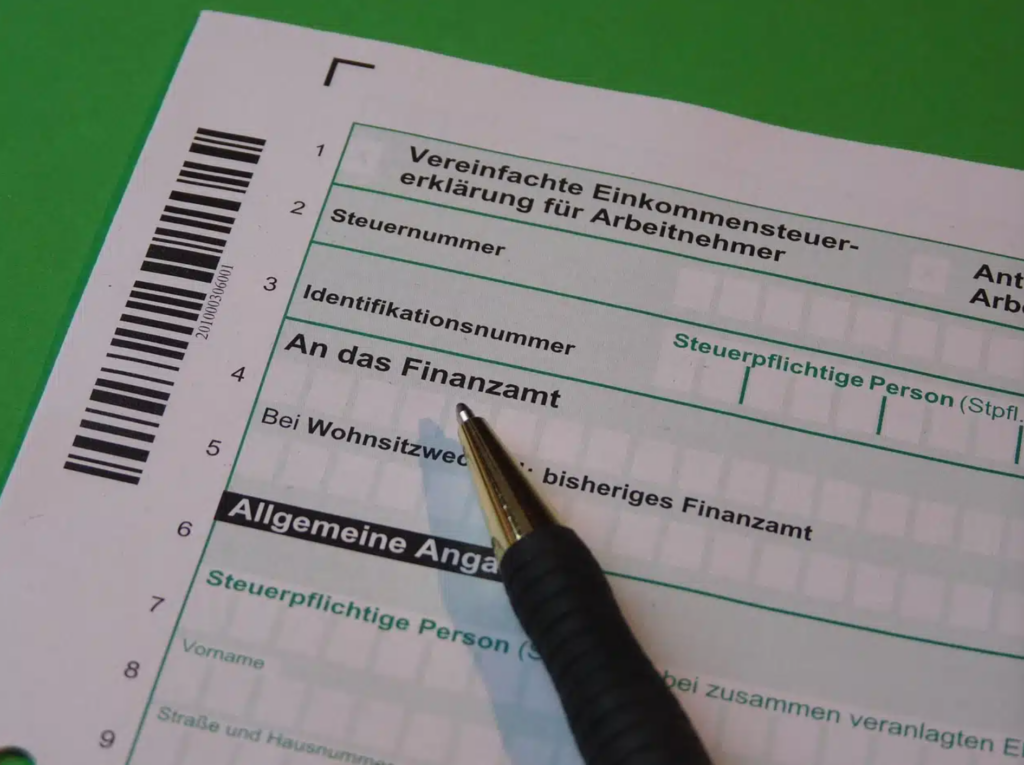
To change the tax class in Germany, you must go to the tax office and fill out a special application. For couples, the entire process is carried out together.
Changing tax classes online
To change the tax class, you can simply apply for a tax class change online on the Elster platform. No proof is required for the change from tax classes 3 and 5 to 4 and 4. The application can be submitted with the partner’s consent.
The fastest and most convenient way to handle tax formalities in Germany is online. Our special program can help accurately calculate the income tax refund for the respective year, taking into account the membership in the respective tax class. We invite you to use our user-friendly and intuitive Taxando application for tax refunds.

Maciej Wawrzyniak
In his private life, Maciej enjoys sporting challenges, playing the guitar, and swimming in the lake. He is also the proud father of three sons.