Germany is one of the leading European countries with a strong economy and a complex tax system. A significant component of this system is the so-called tax classification, which is important for everyone in Germany. Tax Class I deserves special attention as it has a significant impact on the amount of income tax paid by single employees. In this article, we take a closer look at it – we explain the characteristic features, for whom it is intended, and what advantages and disadvantages this form of taxation brings in the German tax system.
Income tax rate in Tax Class I
A fundamental question for people starting to work in Germany is: How high is the wage tax for tax class 1? This is relevant because it has a significant impact on income. In Germany, a progressive tax rate applies, which is the same for all taxpayers regardless of their group. The rule is simple: the more you earn, the higher the assigned tax.
The lowest income tax rate for tax class I is currently 14 percent and applies to taxable income above the basic tax-free allowance (12,084 euros). Up to an annual salary of 65,000 euros, the rate increases progressively and depends on the income. If you earn more, each additional income is taxed at a rate of 42 percent.
Social security contributions in Tax Class I
In tax class 1 in Germany, the following contributions apply:
A simple tax return in 12 minutes?
Choose Taxando!
- Solidarity surcharge – an additional tax contribution of 5.5% of income, currently only applies to people with high incomes.
- Church tax – for everyone registered with a church – the rate is 8 – 9% of income.
- Nursing care insurance – the contribution is 1.525% of the salary, for childless persons an additional contribution of 0.35% can be charged, part of which is borne by the employer.
- Pension insurance – the contribution is 9.3% of the monthly salary up to an amount of 7550 euros, the employer also pays the other half.
- Unemployment insurance – 1.3% of the monthly salary up to an amount of 7050 euros in West Germany and 6750 euros in East Germany.
- Statutory health insurance – 7.3% of the monthly salary up to an amount of 5175 euros – additional contributions may be charged depending on the health insurance company, the employer covers half.
Different rules apply to interns, students, and marginally employed persons with regard to social security.
Benefits in Tax Class I
Numerous tax benefits also affect the final salary and the amount of tax in tax class 1. Especially the basic tax-free allowance – a portion of income that is completely tax-free. In 2025, every working person in Germany can benefit from it, and it amounts to 12.06 euros.
Further benefits in tax class 1 in 2025 are:
- Lump sum for advertising costs – 1230 euros (higher deduction possible by proving actual costs),
- Allowable deduction for special expenses – 36 euros,
- Child benefit – 6,672 euros for both parents,
- Nursing, educational, and training allowance for children – 1320 euros,
- Basic tax-free allowance – 12,084 euros.
Deductions in Tax Class I
Regardless of the assigned tax class, deductions in the tax declaration always depend on the individual situation of the taxpayers. However, it is useful to know which costs should actually be considered if you wish to include them in the tax declaration, instead of using the lump sum of 1230 euros.
This allows for a better refund amount in situations where high advertising costs were incurred in the relevant year. Deductions in tax class 1 include:
- Travel expenses for business trips,
- Expenses for work equipment and clothing,
- Commuting expenses,
- Lump sum for working in a home office,
- Costs for vocational training,
- Union fees.
Difference between Tax Class I and IV
Tax classes I and IV differ in many ways. While tax class 1 refers to single and fiscally independent individuals, class 4 concerns spouses who live, work, and earn in a fixed relationship. In such a combination, both are treated as individual taxpayers, resulting in a lower tax rate.
Difference between Tax Class I and III
Tax class III is intended for spouses, but in cases where one person earns significantly more than the other – then this combination is most advantageous. This class allows couples to benefit from tax advantages arising from the difference in their incomes. Therefore, it is not possible to switch from tax class 1 to 3 without entering a fixed relationship.
Can you switch from Tax Class I to II?
Normally, the German tax office automatically assigns each working person a tax class – mainly considering marital status. Therefore, single persons without children usually have no choice and cannot change the assigned tax class 1.
However, if the situation changes and a change of tax class is desired, this can be done several times a year. It is sufficient to submit a corresponding application to the tax office. Note that other tax classes like III, IV, and V are available even if you live with a person in a registered civil partnership.
For single parents with a child, switching from tax class I to II may be sensible – this allows benefiting from the tax relief for single parents.
Do I have to submit a tax declaration for Tax Class I?
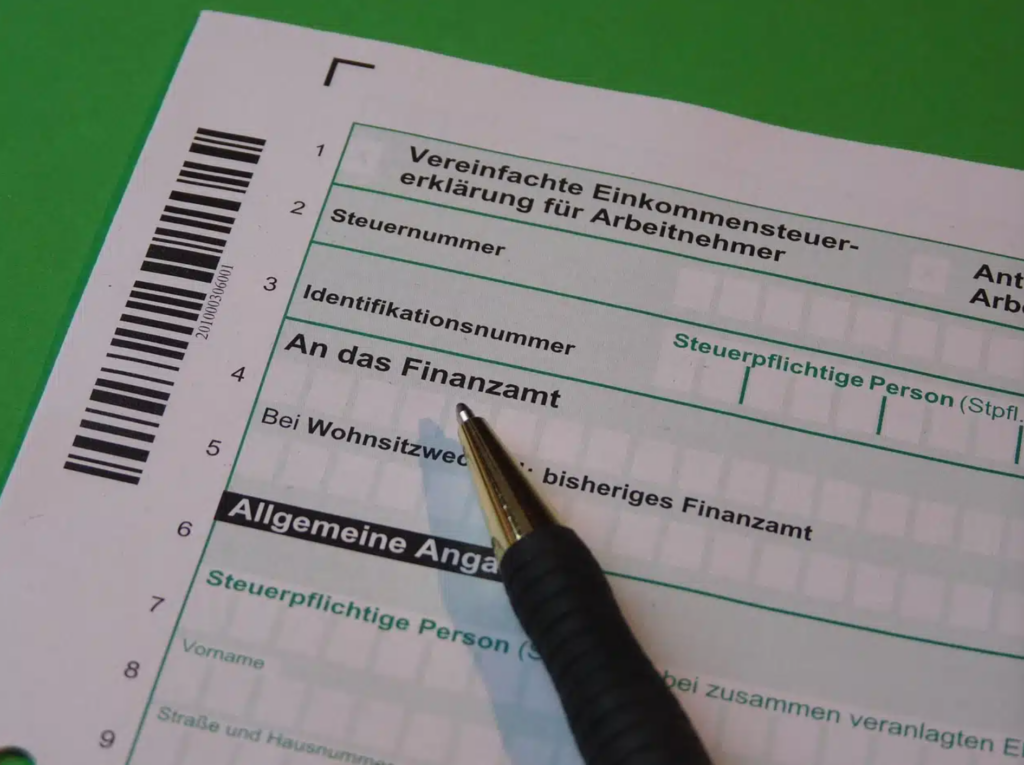
Without precise knowledge of the situation of a person working in Germany, there is no clear answer to this question. The tax class is not the only factor, and many other factors play a role. Although many people in tax class I do not have to submit a tax declaration, it is a more complex matter. It is important to know that the German tax office may request a tax declaration, but it does not have to. Therefore, it is worth dealing with the matter yourself and checking when the obligation to submit a tax return exists.
All important information about the Obligation to file a tax declaration in tax class 1 can be found in our detailed guide. There you will learn exactly in which cases you have to submit a tax declaration and when it is voluntary.
What happens if you don’t submit?
Those who are obliged to submit and miss the deadline receive reminder letters from the tax office that should definitely be observed.These letters are not a mere formality – if further inactivity occurs, late fees of 0.25% per month and fines of up to 500 euros threaten.
For people who have to submit a tax declaration to the German tax office, a functional tax app like Taxando can be helpful. Convince yourself that formalities can be done quickly and easily – we invite you to download our program.

Maciej Wawrzyniak
In his private life, Maciej enjoys sporting challenges, playing the guitar, and swimming in the lake. He is also the proud father of three sons.